War History
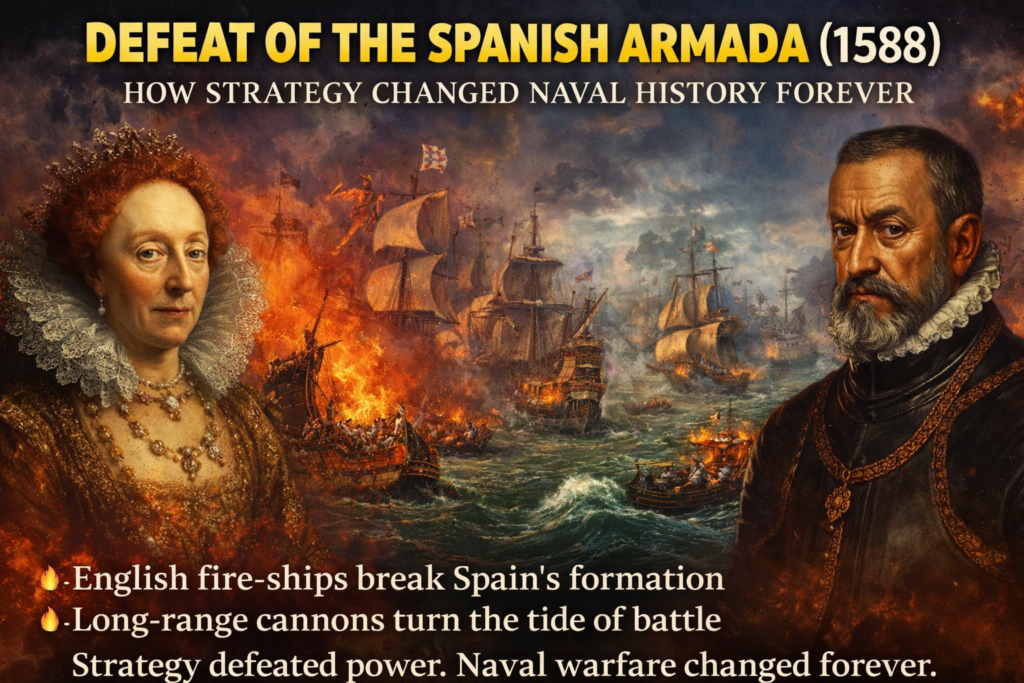
Defeat of the Spanish Armada (1588): How Strategy Changed Naval History Forever.
Defeat of the Spanish Armada (1588): How Strategy Changed Naval History Forever
Defeat of the Spanish Armada (1588): How Strategy Changed Naval History Forever. In 1588, the most powerful navy on Earth set sail with a single objective —
to destroy England and reshape the balance of power in Europe.
This vast fleet was known as the Spanish Armada.
On paper, England stood little chance. Spain commanded the seas with massive warships, thousands of battle-hardened soldiers, and unmatched experience in close-combat naval warfare. Across Europe, many believed England’s defeat was inevitable.
But history took a dramatic and unexpected turn.
What followed became one of the greatest examples of strategy defeating brute force, permanently transforming the nature of naval warfare and maritime power.
Why the Spanish Armada Was Considered Invincible
By the late 16th century, Spain was the world’s leading naval superpower. Its wealth from the Americas funded a navy that dominated global sea routes.
The Spanish Armada inspired fear because it possessed:
Large, heavily armed galleons designed for boarding actions
Thousands of trained infantry soldiers embarked for close combat
A battle doctrine based on grappling, boarding, and overwhelming force
Supreme confidence built through decades of naval success
Spanish commanders firmly believed that once battle closed to short range, no enemy could withstand them.
Victory, they assumed, was inevitable.

England’s Greatest Strength: Refusing Spain’s Battle Plan
England understood a hard truth:
it could not defeat Spain by fighting Spain’s way.
Rather than copying Spanish tactics, English commanders made a decisive and intelligent choice — they refused close combat entirely.
Instead, England focused on:
Faster, more maneuverable ships
Superior long-range cannon fire
Flexible formations and timing
Constant movement to prevent boarding
This refusal to fight on Spain’s terms became the decisive factor of the campaign.
Fire-Ships: Francis Drake’s Strategic Masterstroke
One of the most dramatic moments of the campaign came with the use of fire-ships, orchestrated by English commanders including Sir Francis Drake.
Unmanned ships packed with flammable material were set ablaze and sent drifting into the tightly anchored Spanish fleet.
The consequences were immediate and devastating:
Panic spread through the Armada
Spanish ships cut their anchors to escape
Carefully maintained formations disintegrated
Command and coordination collapsed
In a single night, Spain’s greatest tactical advantage — discipline and formation — was destroyed.
Long-Range Cannons Redefine Naval Warfare
England capitalized on the chaos by keeping its distance and relying on long-range gunnery.
This approach allowed English ships to:
Inflict damage while remaining safe
Control the tempo of battle
Avoid lethal boarding engagements
Spanish ships, while formidable at close range, proved:
Slower and less agile
Ill-suited for extended gunnery duels
Unable to pursue fast English vessels
For the first time in European history, naval warfare shifted decisively from boarding-based combat to artillery-based combat.

Storms, Chaos, and the Collapse of the Armada
As the battered Armada attempted to regroup and return home, nature delivered the final blow.
Violent Atlantic storms scattered the fleet
Damaged ships were wrecked along foreign coasts
Supplies ran critically low
Communication between squadrons broke down
The Armada that had sailed out as a unified force returned to Spain broken, depleted, and defeated.
Why the Spanish Armada Failed
The Spanish Armada did not fail because Spain lacked power or courage.
It failed because:
Its strategy relied on a single method of warfare
England refused to engage on those terms
Tactical flexibility defeated rigid tradition
Intelligence and adaptation overcame raw strength
This lesson would shape naval doctrine for centuries to come.


A Turning Point in Naval History
The defeat of the Spanish Armada was far more than a battlefield victory.
It represented:
A decisive shift in European power politics
The beginning of England’s rise as a global naval force
The triumph of strategy over numerical superiority
One of the most important turning points in maritime history
More Than a Battle — A Victory of the Mind
The fall of the so-called “Invincible Armada” proved a timeless truth:
Wars are not always won by the strongest fleets —
they are won by those who adapt faster, think smarter, and fight differently.
In 1588, naval history changed forever —
not through greater power, but through better strategy.
Defeat of the Spanish Armada 1588, Spanish Armada battle, naval warfare history, England vs Spain naval battle, Francis Drake fire ships, naval strategy history, rise of English navy, maritime warfare evolution