War History
Fort Eben-Emael (1940): How a Small Airborne Force Changed Warfare Forever.
Fort Eben-Emael (1940): How a Small Airborne Force Changed Warfare Forever.
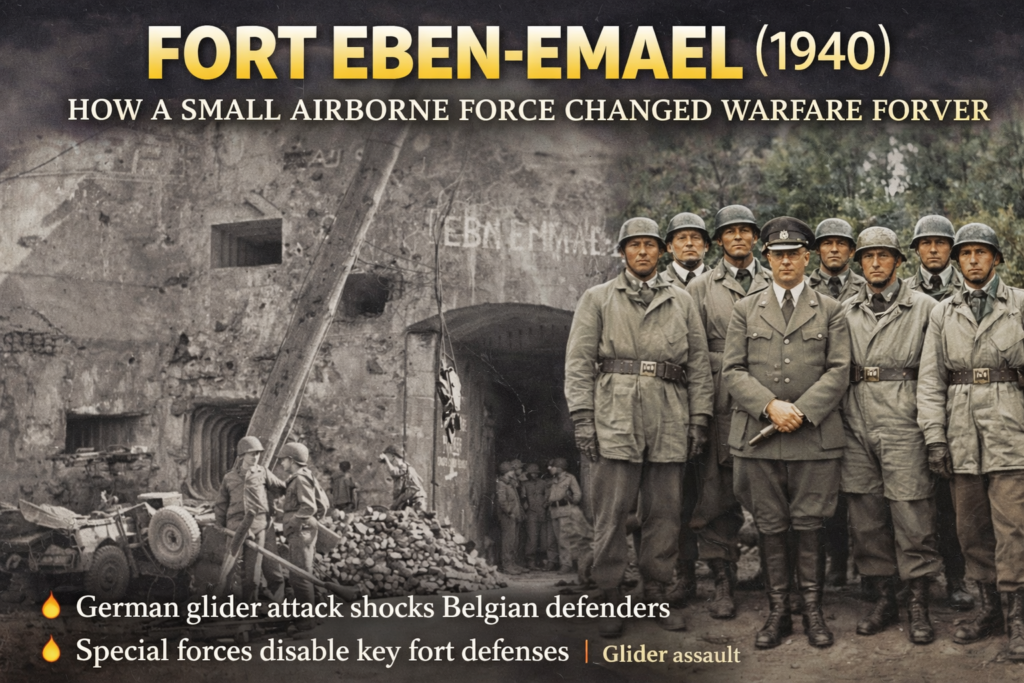
Fort Eben-Emael (1940): How a Small Airborne Force Changed Warfare Forever. In May 1940, Europe was already burning in the early days of World War II. On the Belgian border stood Fort Eben-Emael, one of the strongest and most feared forts in the world.
Many experts believed it was impossible to capture.
Yet, in just a few hours, a small group of German airborne soldiers achieved what large armies could not — and changed modern warfare forever.

source:- AI
Why Fort Eben-Emael Was Considered Unbreakable
Fort Eben-Emael was built to stop any enemy invasion from the east. It guarded important bridges and routes into Belgium.
The fort was protected by:
Thick concrete walls
Heavy steel gun turrets
Deep moats and barbed wire
Anti-aircraft guns
Powerful long-range artillery
Military planners believed that only a long and bloody siege could defeat the fort.
They were wrong.
A New Idea: Attack from the Sky
German military planners thought differently.
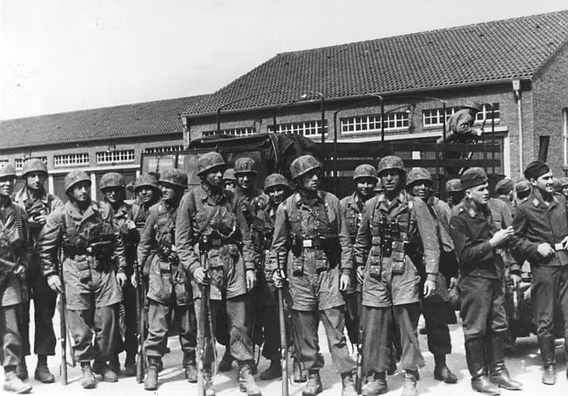
Instead of using heavy bombers or large ground forces, they planned something completely new — a silent airborne assault.
The idea was simple but risky:
Attack from above
Land directly on the fort
Disable key defenses before anyone could react
This type of attack had never been used in real combat before.

source: combat archives
The Secret Weapons: Gliders and New Explosives
The plan depended on surprise, speed, and new technology.
German troops used:
DFS-230 gliders, which could land silently without engines
Hollow charge explosives, designed to break steel and concrete
The mission was not to destroy the entire fort — but to knock out its guns and control points.
10 May 1940: The Silent Landing
In the early hours of 10 May 1940, just before sunrise, the gliders landed directly on top of Fort Eben-Emael.
The Belgian defenders were completely shocked.
They had never expected an attack from the air.
Within minutes:
Major gun turrets were destroyed
Observation posts were neutralized
The fort’s main defenses were disabled
All this happened before German ground troops even arrived.


The Fall of the Fort
By the afternoon, the situation was clear.
The fort could no longer defend itself.
Around 700 Belgian soldiers surrendered, and Fort Eben-Emael fell under German control.
Considering the fort’s reputation, the casualties were surprisingly low on both sides.
Why Fort Eben-Emael Changed Military History
The capture of Fort Eben-Emael became a major turning point because:
It was the first successful glider assault in history
A small team defeated a massive fort using planning and innovation
It reshaped ideas about airborne warfare and special forces
It proved that surprise and intelligence can defeat strong defenses
After this operation, military strategy across the world began to change.


Source: warfare history network
A Lesson That Still Matters Today
The fall of Fort Eben-Emael taught a powerful lesson:
Strength alone does not guarantee victory
New ideas can defeat old defenses
Small, well-trained teams can achieve the impossible
What was once believed unbreakable fell in a single day — not by brute force, but by innovation and planning.
Fort Eben-Emael 1940, World War II airborne assault, Glider attack Eben-Emael, DFS-230 gliders, German airborne troops, Military innovation WWII, Airborne warfare history.